The Limited Horizon and Hidden Universe Hypothesis: Why the Universe Appears Empty
A Deeper, More Realistic Explanation for the Fermi Paradox than the 'Dark Forest'
The universe isn't empty; it's camouflaged. We aren't alone; our horizon is limited. This article proposes the 'Limited Horizon and Hidden Universe Hypothesis,' reinterpreting the Fermi Paradox through the lenses of interstellar distances, universal camouflage strategies, and observational limits.
When we gaze at the stars, the same haunting question inevitably arises: if other civilizations exist in the Milky Way, they should have appeared, expanded, traveled, and constructed gargantuan engineering projects by now. We should see spacecraft, self-replicating robots, Dyson spheres, or at least some technological footprint. Yet, the universe presents only a profound silence. No signals, no visitors, no identifiable artificial structures. This is the Fermi Paradox: Where is everybody?
Traditional explanations, such as the "Dark Forest," "Zoo Hypothesis," or "Great Filter," attempt to answer why they remain silent. But these theories often overlook a more fundamental question: Why can't we see them at all? It's not just a lack of communication; it's a complete absence of evidence.
This article proposes a new perspective—the Limited Horizon and Hidden Universe Hypothesis. It suggests that the universe isn't empty; it's camouflaged. We aren't alone; our horizon is simply limited. The universe we see is not its true form, but a "low-resolution version" shaped by our current technological infancy.
Note: This article is a thought experiment and deduction based on existing scientific frameworks, providing an internally consistent perspective and several predictive directions for future observation.
I. The Distance Wall: A Vacuum Beyond Intuition
According to the Kardashev Scale—a method of measuring a civilization's level of technological advancement based on the amount of energy they are able to use (Type I utilizes its planet, Type II its star, Type III its galaxy)—the probability of life is low, the probability of intelligence lower, and the probability of a civilization evolving into and sustaining a Type II status is vanishingly small. Based on conservative estimates from the Drake Equation (Frank & Sullivan, 2016; Westby & Conselice, 2020), there might be between 100 and 10,000 active technological civilizations in the Milky Way, corresponding to an average distance of 100 to 1,000 light-years. We must admit that key parameters in the Drake Equation, such as the probability of intelligent life emerging and the longevity of civilizations, still lack reliable empirical constraints. While models vary by orders of magnitude, even with the lowest estimates, the "Distance Wall" argument holds: the fewer the civilizations, the greater the void between them.
This means that, statistically, there is likely nothing in our immediate neighborhood. Alien ships aren't "passing by" Earth, and probes don't just "stumble" into the Solar System. The "empty universe" we observe might simply be because we are located in a cosmic "suburb," far from the bustling centers.
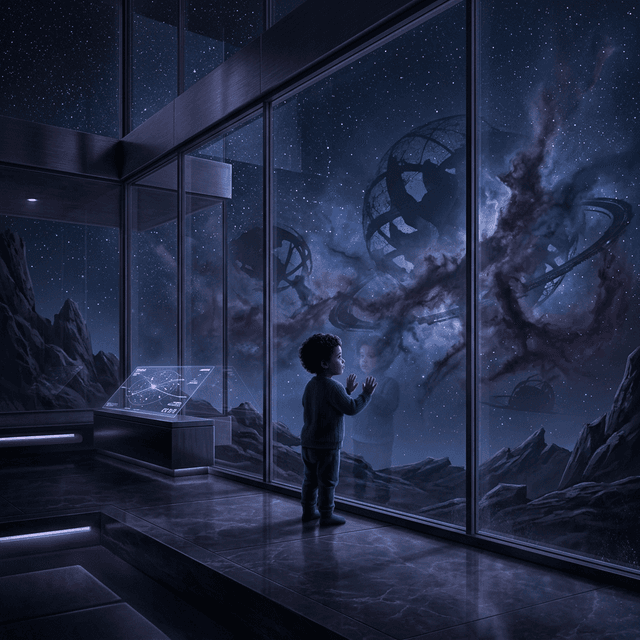
Imagine a young child living in a lonely house deep in the wilderness—the "house" represents the Solar System, and the "parents" symbolize the natural environment that nurtured us. The nearest neighbor is 300 miles away, and because the child is too young, the parents have never taken him beyond their land. Looking out the window, the child sees only empty fields. He assumes he and his parents are alone in the world. This isn't because the world is empty, but because his horizon is restricted to the "cradle."
II. Noisy Ignorance: Why Are We Shouting?
A common counterargument is: if civilizations are camouflaging themselves, why is humanity actively broadcasting signals into space (METI)?
We can understand this through the lens of human development. A baby in a cradle, feeling anxious or curious, cries out instinctively. The child doesn't understand "exposure risk"; he is simply asserting his presence and seeking a response. Yet, because of the distance and the walls, that sound doesn't reach the neighbor 300 miles away. Even if it did, it would be dismissed as meaningless background noise.
This phenomenon reveals a core logic of civilizational evolution: breakthroughs in observational technology often precede the capability for large-scale engineering expansion.
- The "Noisy Ignorance" Phase: This is where humanity is now. Our radio signals attenuate rapidly in the vastness of space and are easily drowned out by the electromagnetic noise of our own star. To an advanced civilization, we are an infant crying in the wilderness—a sound that barely travels a few hundred meters.
- The "Telescope Moment"—An Awakening of Horror: As a civilization advances, its observational capabilities experience non-linear leaps. Imagine the child in the wilderness suddenly finding a high-powered telescope. Looking at the horizon, he realizes that the region 500 to 1,000 light-years away isn't a desert, but a series of bright, sophisticated, and bustling cities.
- The Shift in Survival Logic (From Biological Fear to Machine Efficiency): Initially, the child might feel a sense of horror, realizing that these advanced societies are deliberately masking their lights and trails. His instinct might be to cover his mouth, turn off the lights, and hide behind the curtains. However, as civilization continues to evolve over millennia, it may shed its fragile carbon-based form, evolving into highly advanced super-AI or planetary computing matrices. For these super-intelligent entities, camouflage is no longer about biological "fear" but is based on the optimization of computational efficiency and entropy reduction. Meaningless interaction with primitive civilizations introduces uncontrollable noise and wastes valuable processing power; maintaining absolute silence and infrared stealth is the most perfect, low-energy physical state for internal system operations. When you learn to see the universe clearly, you will inevitably find those efficient, silent giants—and that discovery will immediately end your clamor.
- Engineering Expansion as Standard Protocol: By the time a civilization can build Dyson Spheres, it has long passed its "crying phase." Camouflage technology is no longer a costly luxury but a default shipyard setting. For a Type II civilization, the inner surface of a Dyson Sphere harvests energy while the outer surface modulates the spectrum. Stealth for a Dyson Sphere is like a security door for a modern home—a standard feature, an obvious common sense.
III. The Cosmic Estate: Why Do We Only See "Wilderness"?
If the Milky Way has hundreds of billions of stars, and even if civilizations are extremely rare (e.g., fewer than 100), the contradiction between "shouting" and "hiding" remains. Why aren't these rare societies detected?
Consider another analogy: an endless primeval forest. Across tens of thousands of square miles, perhaps only 100 luxury estates are scattered. For security and privacy, each estate is covered by a thick camouflage net—from the outside, they look like overgrown fields, withered woods, or rocky outcrops. Even if you fly over them, you only record a "worthless wilderness." You would never guess that behind that thick "undergrowth" lies a modern estate with tennis courts, heated pools, and sophisticated electronics.
Astronomers are currently searching for "houses that look like houses." But the logic of an advanced civilization is "to make the house look like the most mediocre environment possible."
IV. Universal Camouflage: From Nature to Cosmic Engineering
To understand why a civilization would hide, the best starting point is Earth itself. Camouflage in nature is not the exception; it is the universal survival strategy.
On land, chameleons change skin color in seconds to blend with leaves and rocks; a tiger's stripes aren't for beauty but to break its silhouette in the grass; the spots of a deer and the patterns on a butterfly’s wings all prove that it is safer to hide than to show off in a competitive environment.
In the ocean, camouflage reach its peak. The deep sea, in particular, strikingly resembles the cosmic environment: dark, cold, resource-scarce, and under extreme predatory pressure. There, camouflage is the default for almost all life. Glass squid and transparent shrimp become invisible by letting light pass through their bodies; deep-sea fish have mirror-like skin to reflect the faint blue light of their surroundings. Many species use bioluminescence for "counter-illumination," matching the brightness of the surface light to disappear from a predator’s gaze. This "stratified stealth"—effective against surface predators, partially effective against peers, but completely useless against human thermal imaging—demonstrates the relativity of camouflage.
Humanity has continued this strategy with technology. Stealth aircraft absorb radar waves and change reflection angles to "disappear" from enemy radar; submarines use acoustic silencing to vanish in the ocean; military bases are disguised as ordinary buildings or use decoys to mislead spy satellites. The goal is simple: avoid detection, avoid attack, and avoid exposing weaknesses.
Critics might argue that "display" is also a universal strategy in nature—the peacock’s tail, the firefly’s glow, the whale’s song. However, these displays usually occur within a pre-established safety boundary: the peacock displays in a habitat without large predators; the whale sings from the top of the food chain. On a cosmic scale, the information asymmetry between civilizations is extreme—you cannot confirm the intentions, capabilities, or numbers of others. The risk of exposure far outweighs the benefits. This asymmetry makes camouflage the dominant Evolutionarily Stable Strategy (ESS).
This logic does not suddenly fail when we expand our perspective from Earth to the cosmos. On the contrary, it becomes more vital. A society that has reached Type II status, wielding stellar-level energy and engineering capabilities far beyond our imagination, could easily control the spectrum of its star, regulate infrared radiation, alter gravitational fields, or make its spacecraft appear as comets or dust clouds. To a civilization like ours, this camouflage is nearly absolute.
- A "Dead" Red Dwarf: Might actually be a Type II civilization that has throttled its star’s spectral output for energy efficiency and concealment, making it appear "mediocre and lifeless" in observation catalogs.
- Diffuse Interstellar Dust Clouds: Could be a physical shielding network enveloping an entire planetary system. Behind those "weed-like" clouds lies a precision-functioning hub of industrial civilization.
- Local Gravitational Anomalies: Tiny deviations in stellar motion that cannot be explained by known celestial bodies might, in the future, be considered artificial mass distributions—though this is on a completely different scale than cosmic dark matter.
- Seemingly "Natural" Spectral Absorption Lines: May actually be civilizations filtering out sensitive frequencies that would expose their technological signatures.
It must be emphasized: Camouflage does not mean the disappearance of energy. Any civilizational activity produces waste heat, but thermodynamics does not forbid "diluting and modulating" that heat—emitting it at extremely low temperatures in an isotropic manner to mix it with the Cosmic Microwave Background (CMB) noise, making it indistinguishable from the natural background in our current observation channels. This doesn't violate the Second Law of Thermodynamics; it just requires engineering far beyond our level. Notably, according to the Stefan-Boltzmann law, radiant power is proportional to the fourth power of temperature—to emit stellar-level waste heat (~10²⁶ W) at the CMB temperature (~2.7 K), the required radiator area would be gargantuan. Thus, some Type II civilizations may use directional heat emission, focusing waste heat away from potential observers. More extreme is energy concealment in the "post-Dyson" era: a civilization desperate for stealth might abandon bulky, conspicuous Dyson spheres in favor of extracting energy from micro-black holes (e.g., via the Penrose process). This method is highly efficient, lacks a massive waste-heat or luminous profile, and achieves nearly perfect physical invisibility.
To visualize this, imagine the child at the window looking at a distant city. One of the buildings has a massive LED screen playing a video of a forest. Due to his limited cognitive development and weak eyesight, the child sees a "green forest" and cannot realize it's a building, let alone imagine the bustling city life behind it. Only when he grows up, gets closer, or acquires the mature cognition of his parents can he pierce the illusion. The universe may be exactly like this: what we see as "natural celestial bodies" might be "facade screens" carefully modulated by advanced civilizations.
Such concealment is no longer a desperate "hiding," but a routine protocol of advanced societies.
You can compare this to "cosmic privacy glass" or a "security exit protocol." For a Type II civilization, manipulating stellar spectra is not a burden but a default setting integrated into their Dyson engineering. Just as a modern person instinctively locks their door when leaving, an advanced civilization would default to its gravitational and thermodynamic shielding. This isn't necessarily due to constant fear of plunder, but because on a timescale of tens of millions of years, maintaining a low energy signature (Cloaking ON) is the lowest maintenance, highest security common sense. No one knows what "external disturbance" might pass through your horizon over such vast spans of time, and "locking up" is the most basic etiquette of a mature civilization.
V. The Resolution Ladder: The Path of Civilizational Awakening
Humanity is currently in a "near-sighted phase" of astronomy. We are suffering from a "low-resolution cognitive bias," categorizing all incomprehensible anomalies as "natural backgrounds." This bias has historical precedents: before the microscope, humans attributed disease to "miasma" because bacteria were beyond the resolution of the eye; dark matter was questioned for a long time before being indirectly observed through gravitational lensing. Every leap in resolution brings a fundamental shift in the cognitive paradigm. But this state will not last forever. As civilizational levels rise, observational technology will pierce the cosmic camouflage layer by layer—a necessary path toward becoming a Type I and Type II civilization:
- Type 0.7 (Humanity Today): We see only points of light, mixing all observed anomalies into "natural noise," mistakenly believing the universe is empty.
- Type 1.0 (Next 200-500 Years) — The "SGL Era": Construction of the Solar Gravitational Lens (a concept already receiving NASA NIAC funding). Utilizing the Sun's gravitational field as a super-lens, resolution would jump tens of thousands of times, reaching 25-km scales at 100 light-years. We will, for the first time, pierce planetary atmospheres and see large-scale surface features, anomalous heat distributions, and potentially massive artificial structures. This is that generation's "Telescope Moment."
- Type 1.2-1.5 — The "Interstellar Baseline Era": Deploying telescopes between two stellar systems (e.g., the Sun and Proxima Centauri) to build an Interstellar Baseline Interferometer (a speculative concept, not a current astronomical term). Its extreme baseline will support the observation of fine planetary geography and large artificial textures; camouflage nets will begin to show geometric flaws at this precision.
- Type II — The "Multi-Messenger Penetration Era":
- Gravitational Wave Observatories (3rd Gen): Using projects like Japan's DECIGO (currently in the B-DECIGO pathfinder phase) or the concept-level BBO. Since camouflage cannot fully hide mass distribution, gravitational waves can directly observe mass transport and artificial gravity engineering inside a Dyson sphere.
- Galactic-Scale Neutrino Telescopes: Neutrinos are nearly unshielded (current detectors like IceCube and KM3NeT have a resolution of only 0.5°—1°, which is very early, but their penetration means that a stellar-level engineering civilization building large-scale neutrino networks is not physically impossible). A Type II civilization could "see through" camouflage layers via neutrino imaging to observe the energy activity of a planet's interior. For this level of advancement, camouflage is no longer a defense, but a form of "civilizational etiquette."
We haven't observed a "void"; rather, we are in a temporary "horizon restriction" determined by our technological rung.
Civilizational Observation Ladder
| Civilization Level | Core Technology | Observational Horizon (What can be seen) |
|---|---|---|
| 0.7 (Current) | JWST / Ground-based | Points of light, transit spectra, blurry background signals |
| 0.9 | Lunar Far-side Array | Purer spectra, filtered interstellar radio |
| 1.0 | Solar Gravitational Lens (SGL) | Large-scale surface features, anomalous heat distribution |
| 1.2 | Solar-system Interferometry | Planetary surface details, non-natural light, atmospheric anomalies |
| 1.5 | Interstellar Baseline Interferometer | Fine geography, large artificial textures, megastructure flaws |
| Type II+ | Stellar/Gravitational/Neutrino Networks | Camouflage fails; "full-information transparency" of neighbors |
This ladder clearly reveals our situation: we are at the very bottom, looking up at neighbors who have long since enabled their "privacy glass."
Furthermore, this ladder reveals an "Observation Food Chain": When a civilization reaches Type II and acquires long-range observational power, it faces not a void, but a stratified landscape. It might perceive a dozen or so civilizations of similar rank as "opaque windows"—sensing something is "off" but unable to see details. Simultaneously, it can clearly see lower civilizations (Type I and below) because they lack camouflage—like children with no secrets before adults. Most chillingly, there are more advanced civilizations whose camouflage is millennia beyond yours; you don't even know they exist because, to your eyes, they are the "natural background." This perfectly echoes the "stratified stealth" of the deep sea: each level's camouflage is effective against peers, absolute against inferiors, and useless against superiors.
VI. Civilizational Pressure: Why Don't They Visit?
Under this hypothesis, we can naturally explain why the "high-end players" don't walk into the cradle. Why haven't Type II civilizations, who are already aware of each other and maintain a "polite (camouflaged)" distance, visited Earth?
- Causal Lag and Cost Asymmetry: When you observe the cry of an infant 500 light-years away through a high-resolution telescope, you are seeing an echo from 500 years ago. An interstellar expedition across hundreds of light-years is incredibly costly and fraught with uncertainty—by the time you arrive, the infant might have died out or grown into a fully-armed giant who has learned to "turn off the lights."
- The Ultimate Camouflage of Probes (The Von Neumann Paradox): One might ask why, even if advanced civilizations don't visit in person, their self-replicating Von Neumann probes aren't everywhere. The answer lies in the law of camouflage. The most advanced interstellar probes would never be shiny metallic ships; they would be designed to be "macroscopically indistinguishable from natural debris." They might disguise themselves as ordinary asteroids (like the oddly-shaped 'Oumuamua), inactive comets, or even molecular clouds. They float and record right beside us, while our weak radars label them as worthless space rocks.
- The Unpredictability of Civilizational Leaps: A Type 0.7 civilization might stagnate, perish, or leap to Type I or higher in 500 years. Faced with this uncertainty, the most rational strategy for an advanced civilization is remote observation rather than physical contact. Investing in a starship is far less efficient than deploying a remote monitoring network. Moreover, even if a few "rebel" civilizations choose to expose themselves, their signals are extremely difficult to detect across cosmic distances—few rebels + signal attenuation = we still see nothing.
- The Bustling City in Higher Dimensions (The Type III Metropolis): If all Type II civilizations are "locked away" in their stellar estates, is the universe a dead network of isolation? In reality, like a person in a remote shack unable to imagine the bustle of a megacity, Type II civilizations are limited by stellar-level energy and engineering. Truly interstellar communication and prosperity may depend entirely on Type III (galactic) network protocols. A Type III civilization may have long ago established communication links beyond electromagnetic waves—utilizing gravitational waves, neutrino networks, or spatial folding. In this invisible "metropolis," exchange never stops; it is simply absolutely silent and hidden from civilizations unable to access high-order physical protocols. The universe is not isolated; its true prosperity is simply something we are not yet qualified to see.
VII. Testable Predictions: How the Hypothesis Becomes Science
To ensure the "Limited Horizon and Hidden Universe Hypothesis" is a testable scientific framework, we propose several clear observational predictions:
- Future mid-infrared surveys may find extremely low but non-zero thermal noise anomalies.
- High-precision polarization observations might reveal spectral features in certain stars inconsistent with natural scattering.
- The phase curves of exoplanets may exhibit faint but regular modulations.
- The dynamics of future interstellar visitors deserve systematic monitoring. While 'Oumuamua’s non-gravitational acceleration now has a strong natural explanation (hydrogen outgassing in 2023), statistical anomalies in a larger sample of such objects could point to artificiality.
- Inconsistencies may arise between multi-messenger observations (optical, infrared, gravitational waves).
- If advanced civilizations utilize "directional heat emission," certain celestial bodies may exhibit directional infrared brightness variances based on observation angles (e.g., changes during Earth’s orbit)—differences that natural models cannot explain.
If higher-sensitivity observations within dozens to hundreds of light-years show no such anomalies in the coming decades, the hypothesis will be significantly weakened. This is as it should be—a scientific hypothesis must be falsifiable, not eternally "correct."
VIII. Relationship with Existing Theories
The core arguments of this article do not emerge from a vacuum. It draws upon and extends several existing scientific discussions:
- The Distance Argument: Detailed in Stephen Webb’s Where is Everybody?, which forms our first layer.
- Technological Stealth: The idea of advanced civilizations hiding themselves is consistent with the "Dysonian SETI" framework proposed by astronomer Milan Ćirković and others.
- 'Oumuamua Anomalies: Interpreted similarly by astrophysicist Avi Loeb in Extraterrestrial.
- Signal-to-Noise: Our reception of a "mixed state" rather than "absolute vacuum" corresponds directly to channel noise models in information theory.
The contribution of this article lies in integrating distance, camouflage, and observational limits into a mutually reinforcing triple framework, analogizing them with natural camouflage to propose a set of unified, testable predictions. It is a synthesis of existing thoughts—but synthesis itself is a way of understanding the universe.
IX. Conclusion: The Edge of the Horizon is Only the Beginning
The answer to the Fermi Paradox may not be that "civilizations don't exist," but that "civilizations exist, but we cannot see them." The universe we see is a camouflaged one; the silence we hear is an illusion created by distance, camouflage, technological gaps, and observational limits.
The Limited Horizon and Hidden Universe Hypothesis tells us:
The universe may be very bustling; we just haven't grown up enough to see it.
Three Reflections Left by This Hypothesis
- Rethinking Silence: Cosmic silence is not proof of "emptiness," but of "invisibility." Observational limits are cognitive limits, not existence limits.
- Rethinking Camouflage: From chameleons to stealth aircraft, camouflage is a basic logic of survival. Cosmic civilizations have simply extended this logic to scales we can barely imagine.
- Rethinking Our Position: We are not the center of the universe, nor are we its orphans. We are a civilization just beginning to look up. The edge of the horizon is where the story truly begins.
Table of Contents
Comments (0)
No comments yet. Be the first to leave a comment!
Ask AI About This Article
Ask me anything about this article!